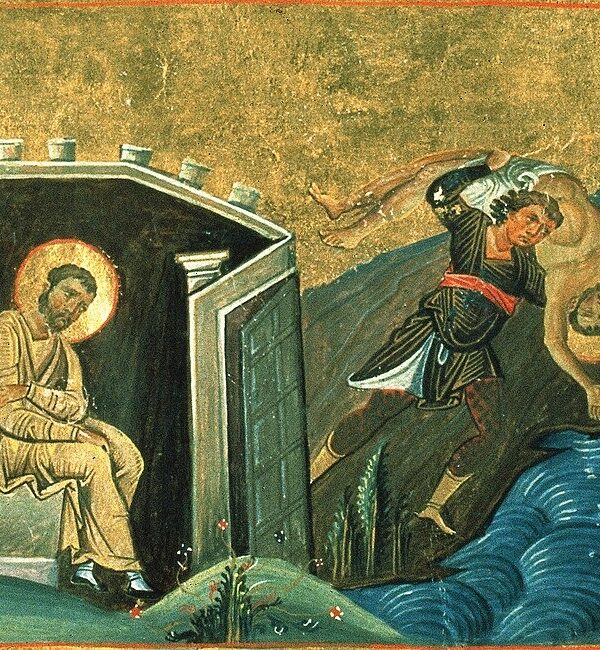
 Lucian of Antioch (Menologion of Basil II).jpg — Authors of Menologion of Basil II (circa 985 AC, Constantinople), Byzantine manuscript illuminators[1]:
Pantoleon with Georgios, Michael the Younger, Michael of Blachernae, Symeon, Symeon of Blachernae, Menas, and Nestor
(Online on Vatican site). Public domain; Wikimedia Commons. Resized for display.
Saint profile
St. Lucian of Antioch
c. 240–312 · Priest, scholar and martyr
Associated with Faith, Perseverance, Martyrs; patronage includes No specific patronage securely documented in the sources reviewed..
Biography and devotion
St. Lucian of Antioch: life, patronage, and devotion
Lucian of Antioch (Greek: Λουκιανός Αντιοχείας c. 240 – January 7, 312), known as Lucian the Martyr, was a Christian presbyter, theologian, and martyr. He was noted for both his scholarship and ascetic piety.
According to Suidas, Lucian was born at Samosata, Kommagene, Syria, to Christian parents, and was educated in the neighbouring city of Edessa, Mesopotamia, at the school of Macarius. However, this tradition might be due to a conflation with his famous namesake, Lucian of Samosata, the pagan satirist of the second century.
At Antioch, Lucian was ordained presbyter. Eusebius of Caesarea notes his theological learning and Lucian's vita (composed after 327) reports that he founded a Didaskaleion, a school. Scholars following Adolf von Harnack see him as the first head of the School of Antioch, with links to later theologians Diodorus of Tarsus and Theodore of Mopsuestia, but that contention is unrecorded in the extant sources.
After the deposition of Antioch's bishop Paul of Samosata, he fell under suspicion for heresy, and was excommunicated. According to Alexander of Alexandria, he remained in schism during the episcopates of three bishops, Domnus, Timaeus and Cyril, whose administration extended from 268 to 303. Lucian was reconciled with the Church either early in the episcopate of Cyril (perhaps about 285), which seems more likely, or under Cyril's successor Tyrannus.
During the persecution of Maximinus Daia, Lucian was arrested at Antioch and sent to Nicomedia, where he endured many tortures over nine months of imprisonment. He was twice brought up for examination, and both times defended himself ably and refused to renounce his Christian faith.
His death is uncertain. He might have been starved to death. Another, more likely, possibility is that he was beheaded. The traditional date ascribed to his execution is January 7, 312, in Nicomedia. There is a late tradition of uncertain origin that he had been drowned in the sea and that his body was returned to land by a dolphin.
He was buried at Drepanum on the Gulf of Nicomedia, which was later renamed Helenopolis to honour Helena, mother of Constantine the Great.
He is also commemorated as a saint, with a feast day of January 7 in the Roman Catholic Church and October 15 in the Orthodox Church.
Lucian's theological position is a matter of contention. Attempts to reconstruct his theology from the extant sources have led to contradictory results. Because Arius in a letter addressed Eusebius of Nicomedia as "sylloukianistes" ("Fellow-Lucianist"), Lucian's theology came to be associated with the Arian controversy. Following Adolf von Harnack, many scholars have interpreted the word (which only appears in this instance) as denoting a theological school and have therefore seen not only Eusebius but also Arius and other Arian leaders (among them Maris, Theognis of Nicaea and Asterius) as pupils of Lucian and have transferred Arian views unto Lucian. The first writer to clearly attest such a discipleship for a number of Arian sympathisers—but not for Arius and his closer associates—was the Anomoean church historian Philostorgius. Others have interpreted the word as indicating not a theological link but the special veneration accorded to Lucian by Eusebius, who by that time headed the church of Nicomedia, the place of Lucian's martyrdom. Lucian's veneration increased during the latter half of Constantine's reign, in particular due to the patronage of the Empress Helena. Opponents of Arianism, such as Alexander of Alexandria, countered this veneration by noting Lucian's schismatic past. Marius Victorinus identified the Eusebian party with Lucian. Epiphanius associates Lucian with heretical views about Christ's human soul held by Arians (but also by others) and relates that the Arians venerated Lucian as their martyr and that Lucian lived together with Eusebius at Nicomedia. Associated with Lucian's name is also the Creed of the Dedication passed at the Council of Antioch in 341. This association is unknown to Athanasius of Alexandria and Hilarius of Poitiers, but known and accepted by later writers.
Prayer
St. Lucian of Antioch, pray for us before Our Lord Jesus Christ. Ask him to strengthen our faith, increase our charity, and grant us perseverance in hope. Bring our intentions before him, according to his holy will. Amen.
Sources
Biographical source: Lucian of Antioch. Selected and reformatted from Wikipedia contributors; CC BY-SA 4.0. The adapted biographical text is shared under the same license. Contributor history.
At a glance
- Life dates
- c. 240–312
- Feast day
- January 7 (Roman); October 15 (Eastern)
- Vocation / order
- Priest, scholar and martyr
- Patronage
- No specific patronage securely documented in the sources reviewed.
Relic in the Chasing Saints collection
A relic of St. Lucian of Antioch is present in the Chasing Saints Relic Collection. Private registry details, certificate IDs, provenance notes, and storage information are intentionally not shown publicly.
Reported favors