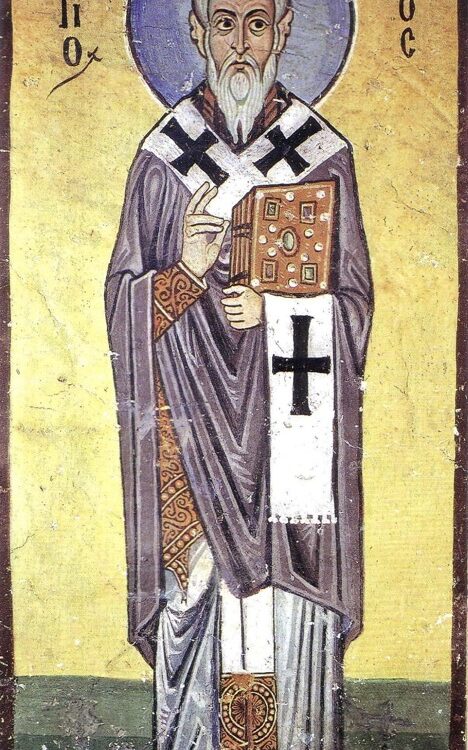
 Artwork: Hosios_Loukas_(south_west_chapel,_south_side)_-_Ignatios.jpg — AnonymousUnknown author. Public domain; via Wikimedia Commons. Resized for display.
Saint profile
St. Ignatius of Antioch
c. 35–107
Associated with Martyrs, Priests; patronage includes Patron of the Church in the Eastern Mediterranean.
Biography and devotion
St. Ignatius of Antioch: life, patronage, and devotion
St. Ignatius of Antioch was the bishop of Antioch in Syria and one of the earliest Fathers of the Church. Born around the middle of the first century, he lived close enough to the apostolic age that later Christian tradition associated him with the generation formed by the Apostles themselves. His patronage is often connected with the Church in the Eastern Mediterranean, bishops, unity of the Church, and Christians preparing to suffer for the faith.
Antioch was one of the great centers of early Christianity. The Acts of the Apostles records that the disciples were first called Christians there, and Ignatius inherited a Church marked by apostolic preaching, persecution, and missionary zeal. As bishop, he guarded the faith against division and false teaching. His strongest written theme is the unity of Christians around the bishop, the presbyters, the deacons, and the Eucharist. He spoke of the Eucharist with extraordinary realism, calling it the medicine of immortality and defending the true flesh of Christ against those who denied the Incarnation.
During the reign of the Emperor Trajan, Ignatius was arrested and sent under military guard to Rome. On that long journey he met delegations from several Churches and wrote seven letters: to the Ephesians, Magnesians, Trallians, Romans, Philadelphians, Smyrnaeans, and to St. Polycarp of Smyrna. These letters are among the most precious documents of early Catholic life, revealing the sacramental, hierarchical, and martyr-centered faith of the second century.
The Letter to the Romans is especially moving. Ignatius begged the Christians of Rome not to prevent his martyrdom, desiring to be ground like wheat by the teeth of beasts so that he might become pure bread for Christ. Around the year 107, he was taken to the arena in Rome and died by being thrown to wild animals. His memory remains one of the clearest witnesses to the early Church’s love for the Eucharist, bishops, unity, and martyrdom.
His letters also show how early Christians understood martyrdom as union with Christ rather than a political gesture. They name bishops, presbyters, deacons, the altar, and the Eucharist in language that later Catholics recognize immediately. For that reason Ignatius is not only an ancient martyr but a major witness to apostolic Catholic worship.
At a glance
- Life dates
- c. 35–107
- Feast day
- October 17
- Patronage
- Patron of the Church in the Eastern Mediterranean
Relic in the Chasing Saints collection
A relic of St. Ignatius of Antioch is present in the Chasing Saints Relic Collection. Private registry details, certificate IDs, provenance notes, and storage information are intentionally not shown publicly.
Reported favors