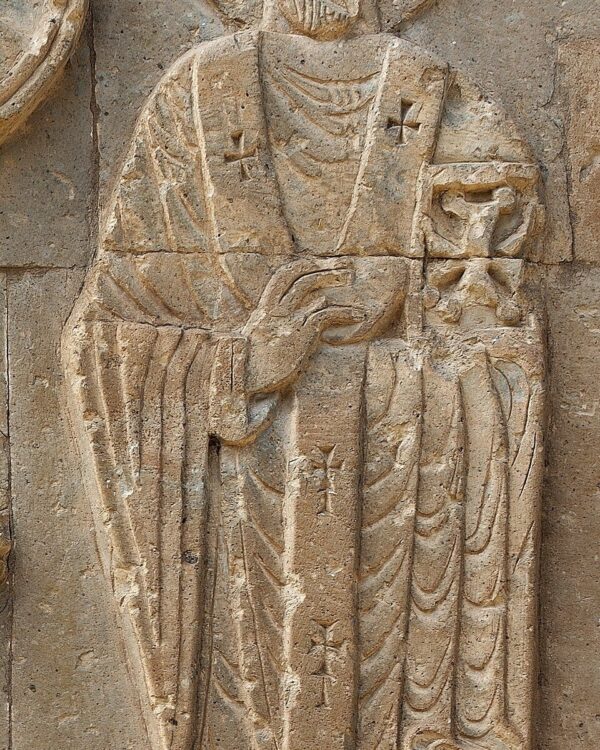
 Gregory the Illuminator Aghtamar bas relief.jpg — User:Dosseman. CC BY-SA 4.0; Wikimedia Commons. Resized for display.
Saint profile
St. Gregory the Illuminator
c. 257–331 · Bishop and evangelizer of Armenia
Associated with Faith, Perseverance; patronage includes Armenia; Nardò, Italy.
Biography and devotion
St. Gregory the Illuminator: life, patronage, and devotion
Gregory the Illuminator (c. 257 – c. 331) was the founder and first official head of the Armenian Apostolic Church. He converted Armenia from Zoroastrianism to Christianity in the early fourth century (traditionally dated to 301), making Armenia the first state to adopt Christianity as its official religion. He is venerated as a saint in the Armenian Apostolic Church and in some other churches.
Gregory is said to have been the son of a Parthian nobleman, Anak, who assassinated Khosrov, the Arsacid king of Armenia. The young Gregory was saved from the extermination of Anak's family and was raised as a Christian in Caesarea of Cappadocia, then part of the Roman Empire. Gregory returned to Armenia as an adult and entered the service of King Tiridates III, who had Gregory tortured after he refused to make a sacrifice to a pagan goddess. After discovering Gregory's true identity, Tiridates had him thrown into a deep pit well called Khor Virap for 14 years. Gregory was miraculously saved from death and released after many years with the help of Tiridates' sister Khosrovidukht. Gregory then converted the King to Christianity, and Armenia then, in 301 AD, became the first country to adopt Christianity as a state religion. Gregory the Illuminator then healed King Tiridates, whom the hagiographical sources say had been driven mad by his sins, and preached Christianity in Armenia. He was consecrated bishop of Armenia at Caesarea, baptized King Tiridates and the Armenian people, and traveled throughout Armenia, destroying pagan temples and building churches in their place.
Gregory eventually gave up the patriarchate to live as a hermit and was succeeded by his son Aristaces. Gregory's descendants, called the Gregorids, hereditarily held the office of Patriarch of Armenia with some interruptions until the fifth century. It is in Gregory's honor that the Armenian Church is sometimes called lusavorchakan ("of the Illuminator") or Gregorian.
In the Armenian tradition, the standard version of the life of Gregory the Illuminator derives from the fifth-century hagiographic history attributed to Agathangelos. According to Agathangelos's account, Gregory was the son of the Parthian nobleman Anak; the later Armenian historian Movses Khorenatsi identifies Anak as a member of the Parthian noble house of Suren. At the incitation of the Sasanian king Ardashir I, who promised to return Anak his domain as a reward, the Parthian nobleman went to Armenia and assassinated the Arsacid king of Armenia Khosrov after gaining his confidence. Anak was then put to death by the Armenian nobles along with his entire family․ Anak's son Gregory narrowly escaped execution with the help of his nurse, whom Khorenatsi calls Sophy, sister of a Cappadocian notable named Euthalius (Ewtʻał). Gregory was taken to Caesarea in Cappadocia, where he received a Christian upbringing.
Josef Markwart distrusted the traditional account, suggesting instead that Gregory grew up near the Roman-Armenian border, perhaps in Neocaesarea or in Lesser Armenia and spoke both Armenian and Greek. According to historian Nicholas Adontz, it is likely that there were originally two independent traditions about the origins of Gregory the Illuminator, both giving the founder of the Armenian church a noble origin; these traditions were combined in the main Armenian version of Agathangelos. The story of Anak serves to connect Gregory to the Arsacid dynasty as a descendant of the Parthian clan of Suren, and also makes Gregory's early life reflect that of Tiridates III in epic fashion. Jean-Michel Thierry described him as of "Cappadocian culture and religion" and credited him with having introduced "Greek civilization to Armenia."
According to Khorenatsi, upon coming of age, Gregory married Mariam, daughter of a Christian named David. He had two children with Mariam: Aristaces and Vrtanes, who would later succeed Gregory as patriarchs of Armenia.
Prayer
St. Gregory the Illuminator, pray for us before Our Lord Jesus Christ. Ask him to strengthen our faith, increase our charity, and grant us perseverance in hope. Bring our intentions before him, according to his holy will. Amen.
Sources
Biographical source: Gregory the Illuminator. Selected and reformatted from Wikipedia contributors; CC BY-SA 4.0. The adapted biographical text is shared under the same license. Contributor history.
At a glance
- Life dates
- c. 257–331
- Feast day
- September 30; Armenian observances vary
- Vocation / order
- Bishop and evangelizer of Armenia
- Patronage
- Armenia; Nardò, Italy
Relic in the Chasing Saints collection
A relic of St. Gregory the Illuminator is present in the Chasing Saints Relic Collection. Private registry details, certificate IDs, provenance notes, and storage information are intentionally not shown publicly.
Reported favors