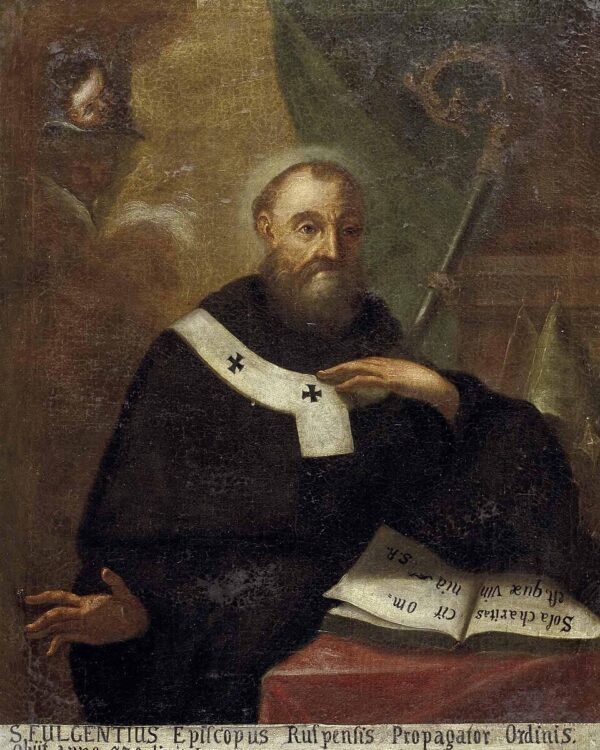
 Fulgentius von Ruspe 17Jh.jpg — AnonymousUnknown author. Public domain; Wikimedia Commons. Resized for display.
Saint profile
St. Fulgentius of Ruspe
Born c. 465; died 1 January, either 527 or 533 · Abbot and Bishop
Associated with Faith, Perseverance; patronage includes No specific patronage securely documented in the sources reviewed..
Biography and devotion
St. Fulgentius of Ruspe: life, patronage, and devotion
Fabius Claudius Gordianus Fulgentius, also known as Fulgentius of Ruspe (462 or 467 – 1 January 527 or 533), was a North African Christian prelate who served as Bishop of Ruspe in what is now Tunisia, during the 5th and 6th century. He is venerated as a saint.
Fabius Claudius Gordianus Fulgentius was born in the year 462 at Telepte (modern-day Medinet-el-Kedima), Tunisia, North Africa, into a senatorial family. His grandfather, Gordianus, a senator of Carthage, was despoiled of his possessions by the invader Genseric, then banished to Italy. His two sons returned after his death; though their house in Carthage had been taken over by Arian priests, they recovered some property in Byzacene.
His father Claudius died when Fulgentius was still quite young. His mother Mariana taught him to speak Greek and Latin. Fulgentius became particularly fluent with the former, speaking it like a native. His biographer says that at an early age Fulgentius committed the entire works of Homer to memory. He quickly gained wide public respect for the conduct of his family's affairs. This reputation helped him to acquire a post as a procurator or tax collector of Byzacena. He soon grew tired of the material life, and this combined with his religious studies, particularly a sermon of Augustine of Hippo on Psalm 36, which dealt with the transitory nature of physical life, convinced him to become a monk.
Around the year 499 he set out to join the hermits of the Thebaid in Egypt, but changed his mind when he learned from Eulalius, Bishop of Syracuse, of the influence of monophysitism on Egyptian monasticism.
He applied to Faustus, a bishop who had been forced from his diocese by the Vandal king Huneric and later set up a monastery at Byzacena. Faustus tried to dissuade Fulgentius because his physical weakness made him a poor candidate for the rigorous life of the monastery. When Fulgentius persisted, Faustus admitted him on a trial basis.
Upon learning of her son's decision, Mariana, who evidently had never been told of Fulgentius's wish, was very upset. She rushed to the gates of the monastery, demanding to know how a church that was supposed to protect widows could deprive her of her only son. Her protestations were ineffective, and Fulgentius was ultimately confirmed in his vocation.
Renewed Arian attacks on the area forced Fulgentius to leave for another nearby monastery. The abbot there, Felix, gave Fulgentius the duty of managing the temporal affairs of the monastery, while he managed the spiritual affairs. The two of them worked well together, and so in 499, during another wave of persecution, they both fled for Sicca Veneria. A local Arian priest had them arrested and tortured after learning the pair were preaching the orthodox Nicene teaching.
In 500, he visited Rome, where he prayed at the tombs of the apostles. His visit coincided with a formal address to the people by king Theodoric, which confirmed Fulgentius in his low esteem for the earthly vanities of this world. He then returned to Byzacena, where he built a monastery, electing to live in an isolated cell. Fulgentius's reputation quickly spread, and he was several times offered the post of bishop of one of the dioceses which had been vacated through the actions of the Arian king Thrasamund. He chose not to accept these offers, knowing Thrasamund had specifically ordered that only Arians be permitted to fill those seats.
Prayer
St. Fulgentius of Ruspe, pray for us before Our Lord Jesus Christ. Ask him to strengthen our faith, increase our charity, and grant us perseverance in hope. Bring our intentions before him, according to his holy will. Amen.
Sources
Biographical source: Fulgentius of Ruspe. Selected and reformatted from Wikipedia contributors; CC BY-SA 4.0. The adapted biographical text is shared under the same license. Contributor history.
At a glance
- Life dates
- Born c. 465; died 1 January, either 527 or 533
- Feast day
- 1 January and 3 January (Augustinian Order)
- Vocation / order
- Abbot and Bishop
- Patronage
- No specific patronage securely documented in the sources reviewed.
Relic in the Chasing Saints collection
A relic of St. Fulgentius of Ruspe is present in the Chasing Saints Relic Collection. Private registry details, certificate IDs, provenance notes, and storage information are intentionally not shown publicly.
Reported favors