Saint profile
St. Charles Spinola
Associated with Martyrs, Religious; patronage includes Jesuit saints and martyrs; varies by saint.
Biography and devotion
St. Charles Spinola: life, patronage, and devotion
Blessed Charles Spinola was a Jesuit priest and martyr, born in Genoa in 1564 into a noble family connected with Spain and Italy. He entered the Society of Jesus and longed for the missions in Japan, where Christianity had grown rapidly but was increasingly threatened by persecution. After years of preparation and delay, including shipwreck and hardship, he reached Japan and gave himself to preaching, catechesis, and the support of hidden Christian communities.
The Japanese mission required courage, language learning, discipline, and secrecy. Spinola worked with other Jesuits and native catechists in a Church that was increasingly forced underground. He taught, administered the sacraments, encouraged converts, and served communities whose faith could cost them property, family security, torture, or death.
In 1618 he was arrested during the Tokugawa persecution. He spent years in harsh imprisonment at Omura with other missionaries and Japanese Christians. The prison became, in Catholic memory, a place of preparation for martyrdom. The captives prayed, encouraged one another, wrote letters when possible, and waited for the witness that seemed inevitable.
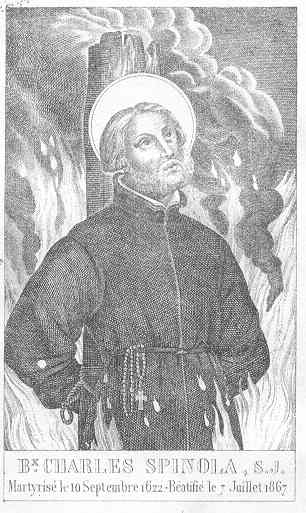
On 10 September 1622, Charles Spinola was martyred in the Great Martyrdom of Nagasaki, when many Christians were burned, beheaded, or otherwise executed. He was burned alive with other missionaries and lay faithful, including women, men, catechists, and children whose courage showed that the Japanese Church was not merely foreign but deeply rooted in local believers.
He was beatified by Pope Pius IX in 1867 among the Japanese martyrs. His life is significant because it joins noble birth, Jesuit learning, missionary patience, and long imprisonment to the final charity of martyrdom. He did not die alone as an isolated hero; he died as part of a missionary Church in which priests, brothers, catechists, and families bore witness together that Christ was worth more than life.
The long imprisonment before his execution is essential to his story. He did not die after a sudden arrest; he had years to grow physically weak while preparing spiritually for martyrdom. Letters and Jesuit reports from the Japanese mission show how carefully the missionaries understood their danger. The Great Martyrdom of Nagasaki included Europeans, Japanese priests, catechists, lay men and women, and children. Spinola’s death therefore belongs to the shared witness of a local Church that had received the faith and was willing to suffer beside its missionaries.
His story should be read with the wider Japanese mission in view. The missionaries depended on hidden Christian households, catechists, and lay collaborators who risked imprisonment or death for sheltering priests. Spinola’s years of captivity made his final witness more deliberate: he had time to prepare, to encourage others, and to offer his suffering for the Christians he had served. His martyrdom shows the Jesuit missionary vocation carried to its last consequence, not in sudden accident but through years of fidelity under pressure.
At a glance
- Patronage
- Jesuit saints and martyrs; varies by saint
Relic in the Chasing Saints collection
A relic of St. Charles Spinola is present in the Chasing Saints Relic Collection. Private registry details, certificate IDs, provenance notes, and storage information are intentionally not shown publicly.
Reported favors