Saint profile
St. Catherine of Bologna
1413–1463
Associated with Mystics, Religious, Saints; patronage includes Artists; liberal arts; spiritual purity.
Biography and devotion
St. Catherine of Bologna: life, patronage, and devotion
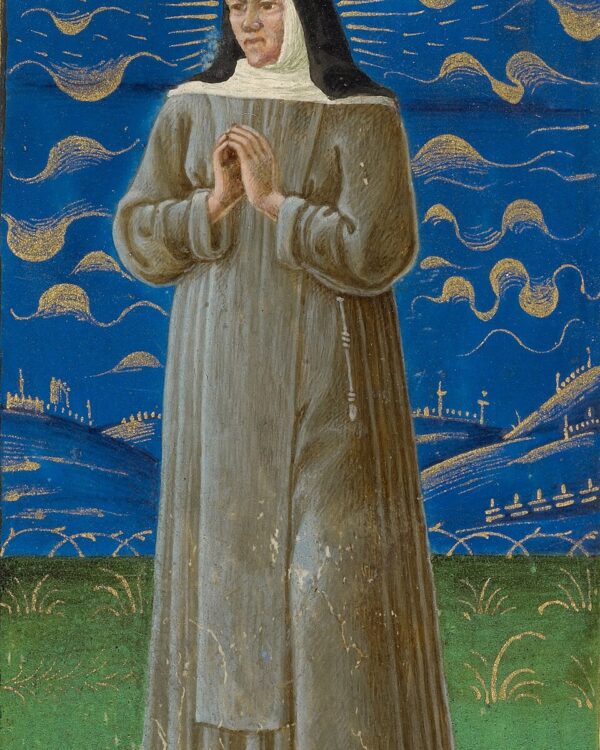
St. Catherine of Bologna was born in 1413 into a noble family connected with Ferrara. She became a Poor Clare nun, mystic, artist, musician, spiritual writer, and patron of artists and the liberal arts. Her life is an example of culture placed at the service of prayer. As a young girl she was educated at the court of Ferrara, where she learned reading, music, painting, and the refined skills expected of noble women. Court life did not satisfy her. She entered religious life, first among a group of devout women and then in the Poor Clare tradition. Eventually she helped found and govern the Corpus Domini monastery in Bologna. Catherine’s spirituality was marked by humility, obedience, and spiritual combat. She experienced temptations and trials, and she wrote about the weapons needed to resist them. Her best-known work, The Seven Spiritual Weapons, gives practical counsel for souls seeking perseverance. It reflects not theory alone but lived experience: the need for diligence, distrust of self, confidence in God, meditation on Christ’s Passion, remembrance of death, remembrance of heavenly glory, and Scripture. She was also known for mystical gifts, including visions of Christ and the Blessed Virgin Mary. Her artistic gifts continued in the monastery, where tradition attributes paintings and manuscript work to her. She governed as abbess with maternal firmness and deep concern for her sisters. Catherine died in 1463. Her body was found incorrupt and is venerated in Bologna, seated in a chapel of Corpus Domini. This remarkable visible witness has drawn pilgrims for centuries. Canonized in 1712, St. Catherine of Bologna shows that art, music, learning, and imagination can become holy when purified by prayer. She did not reject beauty; she taught it to kneel before Christ. Her artistic life was not separate from her sanctity. Medieval and Renaissance convents often preserved music, manuscript work, embroidery, painting, and devotional drama as forms of prayer. Catherine’s patronage of artists rests on this union of disciplined craft and contemplation. Her incorrupt body, still seated in Bologna, makes her one of the most visually striking saints of the Poor Clare tradition.
Her preserved body, seated rather than lying down, remains one of the most striking signs associated with her cult. Pilgrims who visit the chapel of Corpus Domini encounter a saint who was painter, musician, abbess, and spiritual combatant. Her profile should therefore include both beauty and battle: the ordered creativity of art and the disciplined resistance to temptation that she taught in her writing.
The incorrupt body preserved at Bologna made her devotion unusually tangible. Pilgrims see not a distant idea but the remains of a woman who painted, prayed, governed, suffered, and wrote. Her holiness is therefore especially concrete for artists and contemplatives: beauty and spiritual warfare can belong to the same vocation.
At a glance
- Life dates
- 1413–1463
- Feast day
- Mar 9
- Patronage
- Artists; liberal arts; spiritual purity
- Incorrupt status
- Her incorrupt body is venerated seated in Bologna.
Relic in the Chasing Saints collection
A relic of St. Catherine of Bologna is present in the Chasing Saints Relic Collection. Private registry details, certificate IDs, provenance notes, and storage information are intentionally not shown publicly.
Reported favors