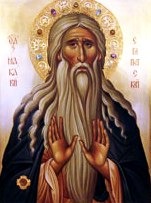
 Saint Macarius the Egyptian.jpg — Unknown (reedited by uploader). Public domain; Wikimedia Commons. Resized for display.
Saint profile
St. Macarius of Egypt
died 391 AD · Venerable Monk and Elder
Associated with Faith, Perseverance; patronage includes No specific patronage securely documented in the sources reviewed..
Biography and devotion
St. Macarius of Egypt: life, patronage, and devotion
Macarius of Egypt (c. 300 AD – 391 AD) was an Egyptian Christian monk and grazer hermit. He is also known as Macarius the Elder or Macarius the Great.
Macarius was born in Lower Egypt. A late tradition places his birthplace in the village of Shabsheer (Shanshour), Roman Egypt around 300 AD. He tended cattle as a boy. As a young man, with a strong call to solitude, he constructed near his home a small cell where he prayed continually and wove mats. At some point before his pursuit of asceticism, Macarius made his living smuggling saltpeter in the vicinity of Nitria, a vocation which taught him how to survive in and travel across the wastes in that area.
Macarius is known for his wisdom. His friends and close kin used to call him Paidarion Geron (Ancient Greek: Παιδάριον Γέρων, which when compounded as Paidiogeron led to Coptic: Ⲡⲓⲇⲁⲣ Ⲓⲟⲩⲅⲉⲣⲟⲛ, Pidar Yougiron) which meant the "old young man", i.e. "the young man with the elders' wisdom."
At the wish of his parents Macarius entered into marriage, but was soon widowed. Shortly after, his parents died as well. Macarius subsequently distributed all his money among the poor and needy. He found a teacher in an experienced Elder, who lived in the desert not far from the village. The Elder accepted the youth, guided him in the spiritual science of watchfulness, fasting and prayer, and taught him the handicraft of weaving baskets.
A while later, a pregnant woman accused him of having defiled her. Macarius did not attempt to defend himself, and accepted the accusation in silence. However, when the woman's delivery drew near, her labor became exceedingly difficult. She did not manage to give birth until she confessed Macarius's innocence. A multitude of people then came asking for his forgiveness, but he fled to the Nitrian Desert to escape all mundane glory.
As a hermit, Macarius spent seven years living on only pulse and raw herbs. He spent the following three years consuming four or five ounces of bread a day and only one vessel of oil a year. While at the desert, he visited Anthony the Great and learned from him the laws and rules of monasticism. When he returned to the Scetic Desert at the age of forty, he became a priest. The fame of his sanctity drew many followers. The community, which took up its residence in the desert, was of the semi-eremitical type. The monks were not bound by any fixed rule; their cells were close together, and they met for Divine worship only on Saturdays or Sundays. He presided over this monastic community for the rest of his life.
For a brief period of time, Macarius was banished to an island in the Nile by the Emperor Valens, along with Macarius of Alexandria, during a dispute over the doctrine of the Nicene Creed. Both men were victims of religious persecution by the followers of then Bishop Lucius of Alexandria. During their time on the island, the daughter of a pagan priest had become ill. The people of the island believed that she was possessed by an evil spirit. Both saints prayed over the daughter, which in turn had saved her. The pagan people of the island were so impressed and grateful that they stopped their worship of the pagan gods and built a church. When word of this got back to the Emperor Valens and Bishop Lucius of Alexandria, they quickly allowed both men to return home. At their return on 13 Paremhat, they were met by a multitude of monks of the Nitrian Desert, numbered fifty thousand, among whom were Pishoy and John the Dwarf.
Prayer
St. Macarius of Egypt, pray for us before Our Lord Jesus Christ. Ask him to strengthen our faith, increase our charity, and grant us perseverance in hope. Bring our intentions before him, according to his holy will. Amen.
Sources
Biographical source: Macarius of Egypt. Selected and reformatted from Wikipedia contributors; CC BY-SA 4.0. The adapted biographical text is shared under the same license. Contributor history.
At a glance
- Life dates
- died 391 AD
- Feast day
- 15 January (West, Roman Catholic); 19 January (Eastern Orthodox) 27 Paremhat (5 April) (Oriental Orthodox)
- Vocation / order
- Venerable Monk and Elder
- Patronage
- No specific patronage securely documented in the sources reviewed.
Relic in the Chasing Saints collection
A relic of St. Macarius of Egypt is present in the Chasing Saints Relic Collection. Private registry details, certificate IDs, provenance notes, and storage information are intentionally not shown publicly.
Reported favors