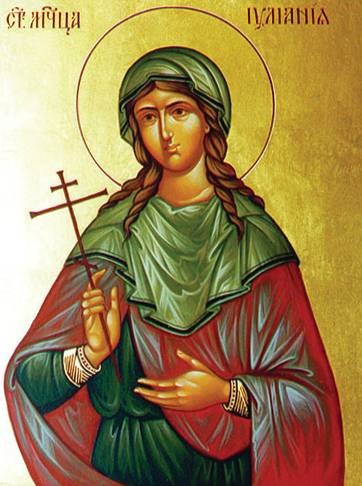
 Juliana of Nicomedia.jpg — Unknown authorUnknown author. Public domain; Wikimedia Commons. Resized for display.
Saint profile
St. Juliana of Nicomedia
Traditionally c. 285–304 · Virgin and martyr
Associated with Faith, Perseverance, Martyrs; patronage includes sickness.
Biography and devotion
St. Juliana of Nicomedia: life, patronage, and devotion
Juliana of Nicomedia (Greek: Ίουλιανή Νικομηδείας) is an Anatolian Christian saint, said to have been born in 285 AD and suffered martyrdom during the Diocletianic persecution in 304. She was popular as a patron saint of the sick during the Middle Ages, especially in the Netherlands.
Both the Latin and Greek Churches mention a holy martyr Juliana in their lists of saints. The oldest historical notice of her is found in the Martyrologium Hieronymianum for 16 February, her place of birth being given as Cumae in Campania (In Campania Cumbas, Natale Julianae).
The only reference to Juliana is in the Codex Epternacensis. That it is nevertheless authentic seems upheld by a letter of Saint Gregory the Great, which testifies to the special veneration of Saint Juliana in the neighbourhood of Naples. A pious matron named Januaria had built an oratory on one of her estates, and for its consecration, she sought relics (sanctuaria, that is to say, objects which had been brought into contact with the graves) of Saints Severin and Juliana. Gregory wrote to Fortunatus II, Bishop of Naples, telling him to accede to the wishes of Januaria. Her life is listed in the Bibliotheca Hagiographica Graeca (BHG) 963 and Bibliotheca Hagiographica Latina (BHL) 4522–4527.
Sometime after Juliana's martyrdom, a noble lady named Sephora travelled through Nicomedia and took a martyr's body with her to Italy to be buried in Campania. It then seems reverence paid to another Juliana, honoured in Nicomedia, might have become conflated with that due to the Juliana who suffered at Cumae.
Little that is satisfactory has survived of the accounts, respectively, of two quite distinct persons.
Details of her biography are unclear. The Acts of Saint Juliana used by Bede in his "Martyrologium" may be legendary. According to this account, Saint Juliana, daughter of an illustrious pagan named Africanus, was born in Nicomedia; and as a child was betrothed to the Senator Eleusius, one of the emperor's advisors. Her father was hostile to the Christians. However, while keeping this to herself, Juliana had been baptised as a Christian. When the time of her wedding approached, Juliana refused to be married. Her father urged her not to break her engagement, but when she refused to obey him, he handed her over to the Governor, her former fiancé. Once more, Eleusius asked Juliana to marry him, but she again refused.
Juliana was beheaded after suffering torture in 304, during the persecution of Maximian. It is said that her torture included being partially burned in flames and plunged into a boiling pot of oil, before finally being beheaded. Along with Juliana, another Christian named Saint Barbara suffered martyrdom, to be likewise venerated as a saint.
Prayer
St. Juliana of Nicomedia, pray for us before Our Lord Jesus Christ. Ask him to strengthen our faith, increase our charity, and grant us perseverance in hope. Bring our intentions before him, according to his holy will. Amen.
Sources
Biographical source: Juliana of Nicomedia. Selected and reformatted from Wikipedia contributors; CC BY-SA 4.0. The adapted biographical text is shared under the same license. Contributor history.
At a glance
- Life dates
- Traditionally c. 285–304
- Feast day
- February 16 (Roman); December 21 (Eastern)
- Vocation / order
- Virgin and martyr
- Patronage
- sickness
Relic in the Chasing Saints collection
A relic of St. Juliana of Nicomedia is present in the Chasing Saints Relic Collection. Private registry details, certificate IDs, provenance notes, and storage information are intentionally not shown publicly.
Reported favors