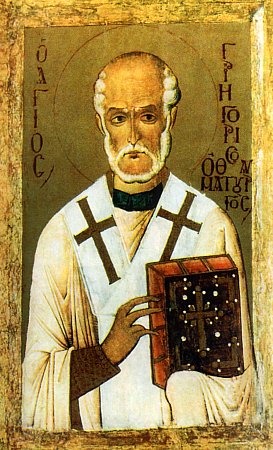
 Grigorii chudotvoretz.jpg — AnonymousUnknown author. Public domain; Wikimedia Commons. Resized for display.
Saint profile
St. Gregory Thaumaturgus
Born 213; died 270 · Thaumaturgus ; (Miracle-worker); Bishop, Confessor and Equal to the Apostles
Associated with Faith, Perseverance; patronage includes Against earthquakes, desperate causes, floods, forgotten causes, impossible causes, lost causes.
Biography and devotion
St. Gregory Thaumaturgus: life, patronage, and devotion
Gregory Thaumaturgus or Gregory the Miracle-Worker (Ancient Greek: Γρηγόριος ὁ Θαυματουργός, Grēgórios ho Thaumatourgós; Latin: Gregorius Thaumaturgus; c. 213 – c. 270), also known as Gregory of Neocaesarea, was a Christian bishop of the 3rd century. He has been canonized as a saint in the Catholic and Orthodox Churches.
Gregory was born around AD 213 to a wealthy pagan family in Neocaesarea (modern Niksar, then the capital of the area of Pontus in Asia Minor). Little is known of his pastoral work, and his surviving theological writings are in an incomplete state. This lack of knowledge partially obscures his personality, despite his historical importance. His longstanding title Thaumaturgus, meaning "the wonder-worker" in Latinized Greek, casts an air of legend about him. Nevertheless, the lives of few bishops of the third century are so well authenticated; the historical references to him permit a fairly detailed reconstruction of his work.
Originally he was known as Theodore ("gift of God"), not an exclusively Christian name. He was introduced to the Christian religion at the age of fourteen, after the death of his father. He had a brother Athenodorus, and on the advice of one of their tutors, the young men were eager to study at the Berytus in Beirut, then one of the four or five famous schools in the Hellenic world. At this time, their brother-in-law was appointed assessor (legal counsel) to the Roman Governor of Palestine; the youths had therefore an occasion to act as an escort to their sister as far as Caesarea in Palestine. On arrival in that town they learned that the celebrated scholar Origen, head of the Catechetical School of Alexandria, resided there. Curiosity led them to hear and converse with the master. Soon both youths forgot all about Beirut and Roman law, and they gave themselves up to the great Christian teacher, who gradually won them over to Christianity.
In his panegyric on Origen, Gregory describes the method employed by that master to win the confidence and esteem of those he wished to convert, specifically, how he mingled a persuasive candour with outbursts of temper and theological argument put cleverly at once and unexpectedly. Persuasive skill rather than bare reasoning, evident sincerity, and an ardent conviction were the means Origen used to make converts. Gregory first studied philosophy, and theology was afterwards added. But his mind remained always inclined to philosophical study, so much so that in his youth he cherished strongly the hope of demonstrating that the Christian religion was the only true and good philosophy. For seven years, he studied under the mental and moral discipline of Origen (231 to 238 or 239). There is no reason to believe that his studies were interrupted by the persecutions of Maximinus of Thrace; his alleged journey to Alexandria, at this time, may therefore be considered at least doubtful and probably never occurred.
Before leaving Palestine, Gregory delivered a public farewell oration in presence of Origen in which he gave thanks to his illustrious master. This oration is valuable from many points of view. As a rhetorical exercise, it exhibits the excellent training given by Origen, and his skill in developing literary taste and the amount of adulation then permissible towards a living person in an assembly composed primarily of Christians. It contains, moreover, much useful information concerning the youth of Gregory and his master's method of teaching. A letter of Origen refers to the departure of the two brothers, but it is not easy to determine whether it was written before or after the delivery of this oration. In it, Origen exhorts his pupils to bring the intellectual treasures of the Greeks to the service of Christian philosophy, and thus imitate the Jews who employed the golden vessels of the Egyptians to adorn the Holy of Holies.
Prayer
St. Gregory Thaumaturgus, pray for us before Our Lord Jesus Christ. Ask him to strengthen our faith, increase our charity, and grant us perseverance in hope. Bring our intentions before him, according to his holy will. Amen.
Sources
Biographical source: Gregory Thaumaturgus. Selected and reformatted from Wikipedia contributors; CC BY-SA 4.0. The adapted biographical text is shared under the same license. Contributor history.
At a glance
- Life dates
- Born 213; died 270
- Feast day
- November 17; Saturday before first Sunday of Advent (Armenian Apostolic Church)
- Vocation / order
- Thaumaturgus ; (Miracle-worker); Bishop, Confessor and Equal to the Apostles
- Patronage
- Against earthquakes, desperate causes, floods, forgotten causes, impossible causes, lost causes
Relic in the Chasing Saints collection
A relic of St. Gregory Thaumaturgus is present in the Chasing Saints Relic Collection. Private registry details, certificate IDs, provenance notes, and storage information are intentionally not shown publicly.
Reported favors