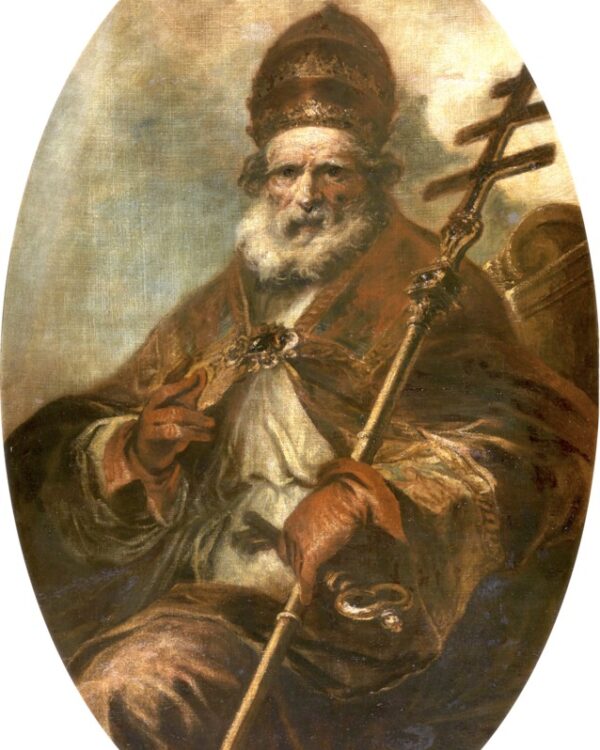
 Artwork: Herrera_mozo_San_León_magno_Lienzo._Óvalo._164_x_105_cm._Museo_del_Prado.png — Francisco Herrera the Younger. Public domain; via Wikimedia Commons. Resized for display.
Saint profile
Pope St. Leo the Great
c. 400–461
Associated with Priests.
Biography and devotion
Pope St. Leo the Great: life, patronage, and devotion
Pope St. Leo the Great was born around the year 400, probably in Tuscany, and became one of the most important bishops of Rome in the ancient Church. Before his election as pope in 440, Leo had served the Roman Church as a deacon and trusted papal diplomat, already known for intelligence, firmness, and pastoral skill. His pontificate came at a time when the Western Roman Empire was weakening and doctrinal disputes threatened the unity of the Church.
Leo’s greatest theological work was his defense of the mystery of Christ. In 449 he wrote the famous Tome to Flavian, a letter explaining that Jesus Christ is one divine Person with two natures, truly God and truly man. This teaching was received at the Council of Chalcedon in 451 and became a major foundation of Catholic Christology. His surviving sermons and letters show a pope deeply concerned with doctrine, liturgy, fasting, charity, and the formation of Christian life.
He is also remembered for courage in a collapsing political world. In 452 Leo met Attila the Hun near Mantua and helped turn him away from Rome. In 455, when the Vandals under Genseric entered the city, Leo negotiated so that Rome was spared burning and massacre. These events made him not only a theologian but also a defender of his people when imperial power could no longer protect them.
Leo died in Rome in 461. He was later declared a Doctor of the Church, and he remains one of only a few popes to be called “the Great.” His life unites preaching, government, diplomacy, courage, and a clear confession of Christ. Catholic devotion remembers him as a shepherd who guarded the faith when both the Empire and the Church were under severe strain.
His preaching also gives the profile a strong literary and pastoral dimension. Many of his sermons were delivered for the great feasts of the liturgical year, explaining Christmas, Lent, Easter, almsgiving, fasting, and the dignity of Christian baptism. They show a pope who could speak doctrine plainly to ordinary believers while also writing with enough precision to guide councils and bishops.
At a glance
- Life dates
- c. 400–461
- Feast day
- November 10
Relic in the Chasing Saints collection
A relic of Pope St. Leo the Great is present in the Chasing Saints Relic Collection. Private registry details, certificate IDs, provenance notes, and storage information are intentionally not shown publicly.
Reported favors